A small randomized acne study offers a practical lesson in reading skincare evidence: the whole treatment matters. Among 37 volunteers, a cream containing chloroxylenol 0.5% plus salicylic acid 2% produced reported reductions in inflammatory and noninflammatory lesions close to those seen with benzoyl peroxide 5% gel over 12 weeks. The cream also had fewer reported problems with redness and photosensitivity at the final assessment, although the accessible abstract does not give adverse-event frequencies.
Those results are encouraging for the tested combination, but they leave several questions open. The study did not isolate salicylic acid, establish formal equivalence, or test other products with the same percentage on their labels. This analysis uses the indexed primary report abstracts for that trial and two related studies, together with available official FDA material. The central question is how much those results tell us about acne lesions, tolerability, formulation differences, and US over-the-counter labeling.
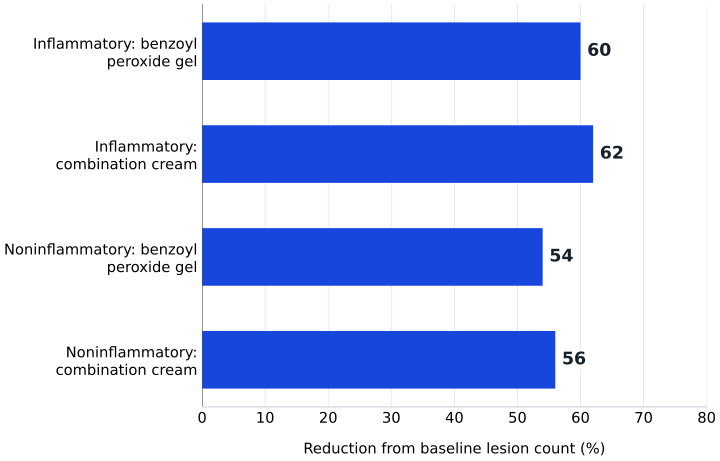
The randomized, double-blind trial assigned 19 volunteers to benzoyl peroxide 5% gel and 18 to chloroxylenol 0.5% plus salicylic acid 2% cream for 12 weeks.
Study facts at a glance
Main comparison: The randomized, double-blind trial assigned 19 volunteers to benzoyl peroxide 5% gel and 18 to chloroxylenol 0.5% plus salicylic acid 2% cream for 12 weeks. Source 1
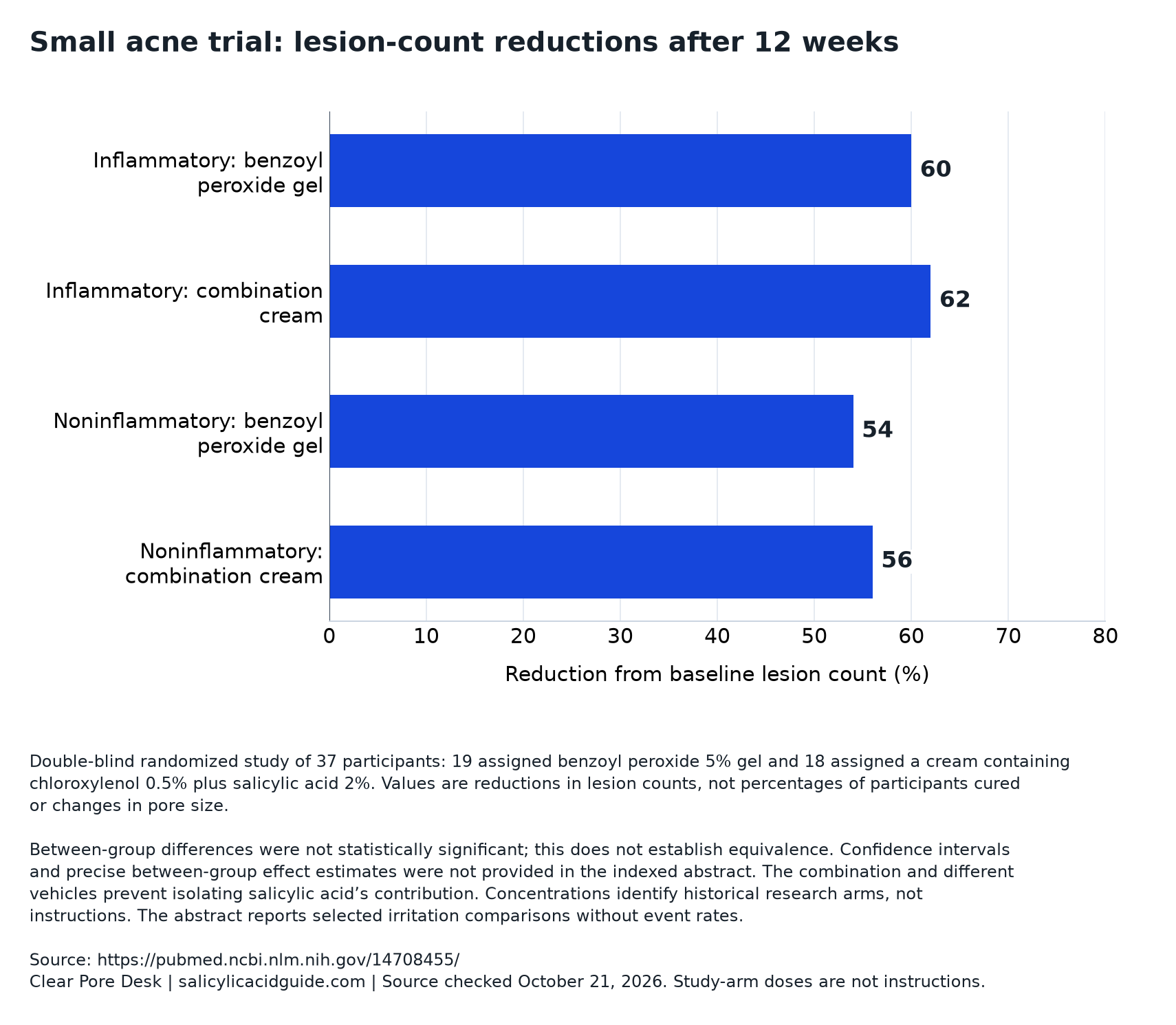
Reported lesion reductions: Inflammatory lesion reductions were 60% with benzoyl peroxide and 62% with the combination cream; noninflammatory reductions were 54% and 56%, respectively. Source 1
Statistical boundary: The between-group lesion comparisons were not statistically significant. That does not establish that the treatments are equivalent. Source 1
Tolerability finding: The cream group had fewer reported erythema and photosensitivity events at week 12, but the abstract supplies P-values rather than event counts or risk percentages. Source 1
US label context: FDA's topical acne monograph lists salicylic acid at 0.5–2% and benzoyl peroxide at 2.5–10%; ingredient concentration alone does not establish full conformity or product-specific approval. Source 4
The study compared two complete topical treatments
The main trial enrolled 37 volunteers with acne and used a randomized, double-blind design. Nineteen received benzoyl peroxide 5% gel, while 18 received a cream containing chloroxylenol 0.5% and salicylic acid 2%, identified in the abstract as Nisal cream. The assigned products were applied topically to the entire face twice daily. These details identify the research arms; they are not a recommended routine for other products.
Clinical evaluations and lesion counts occurred at baseline and at weeks 3, 6, 9, and 12. Repeated visits allowed investigators to follow the treatment course rather than rely only on a final photograph or an overall impression. However, the indexed abstract does not identify a single prespecified primary endpoint, describe the randomization procedure, or explain how masking was maintained between a cream and a gel.
The accessible report also does not provide participant ages, detailed severity distribution, baseline lesion counts, completion numbers, or sponsor information. Those omissions limit assessment of who the findings best represent and how missing observations were handled. The reported allocation is clear; the full population profile and statistical plan are not.
Read the underlying chart data: download CSV or download the source-labeled chart.
Lesion reductions are not clearance rates
At week 12, the reported inflammatory lesion reductions were 60% for benzoyl peroxide and 62% for the combination cream. Noninflammatory reductions were 54% and 56%, respectively. Inflammatory lesions include papules and pustules; noninflammatory lesions include comedones, commonly described as blackheads and whiteheads. The abstract does not specify whether these group-level percentages are means, medians, or another summary.
The numerical separation was two percentage points in each lesion category. That describes the difference between the reported reductions, not the proportion of people who became clear. As a hypothetical illustration, a reduction of 60% from 50 lesions would leave 20 lesions. The study does not supply the starting counts needed to perform that calculation for its actual participants.
Neither percentage establishes how many volunteers achieved clear skin, how visible their improvement felt, or whether scars changed. Lesion counting is useful precisely because it measures something specific. Our guide to salicylic acid for blackheads and whiteheads explains why fewer comedones and smaller-looking pores should not be treated as interchangeable outcomes.
Reported week-12 lesion reductions in the 37-volunteer trial
| Outcome | Benzoyl peroxide 5% gel | Chloroxylenol 0.5% + salicylic acid 2% cream |
|---|---|---|
| Inflammatory lesion reduction | 60% | 62% |
| Noninflammatory lesion reduction | 54% | 56% |
| Participants assigned | 19 | 18 |
A nonsignificant difference does not prove a match
The investigators reported no statistically significant between-group difference in reductions of papules and pustules or comedones. Their abstract concluded that the cream was as effective as benzoyl peroxide gel. A more bounded interpretation is that this small study did not detect a difference in those lesion outcomes. The two statements are not statistically identical.
An equivalence study ordinarily defines in advance how large a difference would still count as acceptably similar, then tests whether the uncertainty around the result fits inside that boundary. No equivalence margin or confidence interval is available in the abstract. Without those details, close point estimates cannot establish formal equivalence or rule out clinically meaningful differences.
With only 18 and 19 people assigned to the arms, individual variation could matter substantially. Yet sample size alone does not tell us exactly how uncertain the comparison was: that also depends on baseline counts, variability, and analysis methods. The appropriate conclusion is neither that the cream failed nor that the treatments were proven interchangeable.
The cream cannot reveal salicylic acid's separate contribution
Two ingredients and a cream vehicle were tested together against a different active ingredient in a gel vehicle. There was no salicylic-acid-only arm, no chloroxylenol-only arm, and no matching vehicle comparison. Consequently, the study cannot determine how much of the observed improvement came from salicylic acid, chloroxylenol, their combination, or characteristics of the finished cream.
The abstract describes a slightly stronger keratolytic effect with the combination across the study. Keratolytic refers to effects on the outer keratinized skin layer, but the accessible report does not provide a separate numerical estimate or enough measurement detail to connect that observation to a specific ingredient. It should not become proof of permanent pore shrinkage or a broader cosmetic benefit.
Formulation also limits transfer to current shopping choices. A cleanser, liquid, modified preparation, and leave-on cream need not behave alike merely because each lists 2% salicylic acid. The cream-versus-cleanser-and-liquid guide organizes these differences. The trial provides evidence about its tested formulation, not every product sharing one active ingredient.
The tolerability signal needs its missing denominators
At week 12, erythema—skin redness—and photosensitivity were reported as significantly less frequent in the combination-cream group. The abstract gives P = 0.0002 for erythema and P = 0.05 for photosensitivity. These results support a tolerability difference in the tested comparison, but the abstract does not provide counts, percentages, severity grades, or confidence intervals.
A P-value is not an adverse-effect rate. P = 0.0002 does not mean that 0.02% of participants developed redness, and P = 0.05 does not mean a 5% photosensitivity risk. Without event frequencies, readers cannot calculate the absolute risk difference or the number of people who would need to use one treatment rather than the other to avoid an event.
Nor does better tolerability at the final visit establish an absence of irritation throughout treatment. The available summary does not describe earlier event patterns or treatment discontinuations. The useful finding is specific: these two reported reactions favored this cream at week 12. It does not establish that salicylic acid combinations are universally gentler than benzoyl peroxide.
An add-on trial asked a different question
A separate 12-week prospective, randomized, single-blind study enrolled 49 patients with mild to moderate facial acne. It compared clindamycin phosphate plus benzoyl peroxide with that combination plus salicylic acid treatment. Unlike the 37-person trial, it asked whether adding salicylic acid improved an existing antibiotic-containing regimen—not whether one complete cream could perform similarly to benzoyl peroxide gel.
The add-on group had statistically greater reductions in inflammatory and total lesions throughout the reported study weeks, and greater noninflammatory reductions beyond two weeks. Patient- and investigator-rated global improvement also favored the add-on group at the end. However, the abstract gives no numerical effect sizes, confidence intervals, or salicylic acid concentration, so the magnitude of the added benefit cannot be quantified here.
The tolerability result also differed: transient mild to moderate dryness was significantly more frequent with the salicylic acid addition. Both groups had reduced outer-skin hydration, while sebum values decreased in the add-on group. These findings make a simple ingredient-wide claim about comfort untenable. Better lesion results and more dryness can occur together, and an antibiotic-containing research regimen is not a do-it-yourself combination template.
The split-face study tested another formulation again
A third randomized study used an open-label, single-center, split-face design: one side received 2% supramolecular salicylic acid cream and the other received benzoyl peroxide plus adapalene gel for 28 days. Thirty-one patients completed it; that is not 62 independent participants. The indexed abstract does not provide the enrollment denominator needed to establish attrition.
At day 28, reported inflammatory reductions were 47.9% versus 49.8%, noninflammatory reductions were 43.1% versus 42.7%, and total reductions were 44.1% versus 45.6%. None of those between-side comparisons was statistically significant. Measured hydration, transepidermal water loss, brightness, and erythema also did not differ significantly between sides. That does not mean the values remained unchanged over time or that neither treatment irritated skin.
The abstract's title and methods identify adapalene as 0.1%, while its objectives also contain 0.01%; the discrepancy remains unresolved without full-text confirmation. Supramolecular salicylic acid is a modified preparation, not the chloroxylenol combination. Our closer analysis of the split-face study examines why its short duration and paired design require a separate interpretation.
Three studies with different treatment questions
| Study structure | Comparison | Main interpretive boundary |
|---|---|---|
| 37 volunteers; 12 weeks; randomized, double-blind | Chloroxylenol/salicylic acid cream versus benzoyl peroxide gel | Cannot isolate salicylic acid or prove equivalence |
| 49 enrolled; 12 weeks; randomized, single-blind | Salicylic acid added to clindamycin/benzoyl peroxide versus that regimen alone | Better reported lesion outcomes with more transient dryness; numerical benefit unavailable |
| 31 completers; 28 days; randomized, open-label, split-face | Modified salicylic acid cream versus benzoyl peroxide/adapalene gel | Short paired comparison; nonsignificant results do not establish equivalence |
FDA concentration ranges are not a product endorsement
FDA's topical acne monograph M006 lists salicylic acid at 0.5–2% and benzoyl peroxide at 2.5–10%. Those ranges provide US regulatory context, not a ranking of effectiveness. Conformity requires meeting all applicable conditions, rather than simply placing an ingredient within its listed range. The monograph is neither a clinical trial nor product-specific FDA approval.
The 37-person trial also does not establish the current regulatory status of its named cream or validate a different marketed combination. Clinical evidence and label compliance answer distinct questions: one concerns observed outcomes under study conditions; the other concerns the requirements governing a product. The Drug Facts label guide helps separate active ingredients, uses, and warnings.
FDA's cosmetic BHA page adds another boundary. Salicylic acid is commonly called a beta hydroxy acid in cosmetics, but cosmetic exfoliation context is not interchangeable with acne-drug evidence. The page's historical discussion of an industry safety assessment is not FDA product approval or a newly verified research program. Neither context supplies a precise pore-size or wrinkle benefit.
Rare hypersensitivity is different from routine irritation
FDA separately warns about rare serious hypersensitivity reactions associated with some over-the-counter acne products containing salicylic acid or benzoyl peroxide. The responsible ingredient was not established: active ingredients, inactive ingredients, or both could be involved. This safety signal cannot be assigned specifically to the cream in the 37-person trial.
The agency's historical review identified 131 reports through January 28, 2013, including 58 hospitalizations and 50 categorized as anaphylactic. These selected reports lack a denominator of exposed users, so they cannot supply an incidence rate or compare the two active ingredients fairly. A small acne trial likewise cannot reliably characterize an uncommon serious reaction.
FDA advises stopping the product and seeking emergency care for throat tightness, breathing difficulty, faintness, or swelling of the eyes, face, lips, or tongue. That is different from ordinary local dryness or stinging. For nonemergency symptom descriptions, the irritation-versus-purging guide emphasizes observation rather than assuming that worsening symptoms prove treatment is working.
The next useful evidence would resolve formulation and durability
A larger study could clarify whether the close lesion reductions persist with more precise confidence intervals. Matching vehicles or including separate ingredient arms would help distinguish the contribution of salicylic acid from the rest of the formula. Explicit primary outcomes, baseline severity, missing-data methods, and participant-level clearance results would make the findings easier to interpret clinically.
Longer follow-up would address questions the 12-week comparison leaves unanswered: whether improvement persists, whether tolerability changes, and what happens after treatment ends. Detailed adverse-event counts would also allow absolute comparisons instead of relying on statistical significance alone. Sponsor and funding disclosures are unavailable in the accessed trial abstracts, another information gap rather than evidence of a particular influence.
Editorial interpretation: a commercial decision requires a separate documentary check. The CoreAge Rx review and Likeness Rx review can be used to examine product descriptions and purchase or renewal terms. Neither review link implies that a provider offers the studied formulation, condition-specific care, or the trial's outcomes. A purchase agreement is not a bridge between different formulations.
Questions about the evidence
Did the combination cream outperform benzoyl peroxide?
Not on the reported lesion-count comparisons. Its reductions were numerically two percentage points larger in both categories, but the between-group differences were not statistically significant. Redness and photosensitivity favored the cream at week 12. Those are separate outcomes, so a tolerability advantage should not be relabeled as superior acne efficacy.
Does this establish that salicylic acid alone is as effective?
No. Salicylic acid was combined with chloroxylenol in a cream, and the comparator was benzoyl peroxide in a gel. Without ingredient-only and vehicle controls, the study cannot isolate salicylic acid's contribution. It also cannot establish that a different 2% product will reproduce the same reductions.
Why did adding salicylic acid increase dryness in another trial?
That study tested salicylic acid alongside clindamycin and benzoyl peroxide, a different treatment context. More transient dryness was observed, but the abstract does not establish which formulation feature caused it. The finding shows why tolerability must be assessed for the actual regimen rather than inferred from one ingredient's reputation.
Do these results demonstrate smaller pores?
No. The main trial counted inflammatory and noninflammatory acne lesions, not permanent pore-size change. Fewer blackheads or whiteheads may be a meaningful acne outcome without demonstrating a change in pore anatomy. FDA's acne monograph and cosmetic BHA context do not fill that measurement gap.
What does the evidence say about combining acne products?
It does not justify assembling the research regimens independently. The studies tested defined combinations under their own protocols, and FDA labeling warns that combining topical acne medicines can increase irritation and dryness. The actual product labels and professional assessment matter; the trial's application schedule is a study detail, not a general instruction.
What this evidence supports
The 37-volunteer trial supports a narrow but useful conclusion: over 12 weeks, the tested chloroxylenol–salicylic acid cream produced substantial reported lesion reductions close to those of benzoyl peroxide gel, with a favorable final-visit signal for two adverse effects. It does not establish equivalence, isolate salicylic acid, or validate another formulation. The related studies strengthen the case for asking formulation-specific questions rather than treating ingredient percentages as complete evidence.
Research access and limitations
Study analysis is based on indexed primary report abstracts, not a review of all full texts, protocols, or supplements. Official FDA material supplies regulatory and safety context. Important unavailable details include confidence intervals, complete adverse-event frequencies, funding disclosures, and aspects of endpoint specification and missing-data handling.
Sources & further reading
Commercial sources establish what a seller publishes. They do not independently verify its results. Browse the source register.
- Comparison of chloroxylenol 0.5% plus salicylic acid 2% cream and benzoyl peroxide 5% gel in the treatment of acne vulgaris: a randomized double-blind study.Primary study abstract · checked 2026-10-21. Indexed primary study abstract
- Efficacy of the addition of salicylic acid to clindamycin and benzoyl peroxide combination for acne vulgaris.Primary study abstract · checked 2026-10-21. Indexed primary study abstract
- Efficacy and safety of 2% supramolecular salicylic acid compared with 5% benzoyl peroxide/0.1% adapalene in the acne treatment: a randomized, split-face, open-label, single-center study.Primary study abstract · checked 2026-10-21. Indexed primary study abstract
- FDA OTC monograph M006: topical acne drug productsOfficial FDA information · checked 2026-10-21. Official six-page administrative order, all sections read
- FDA safety communication: serious hypersensitivity to some OTC acne productsOfficial FDA information · checked 2026-10-21. Official FDA Spanish communication; entire safety notice and data summary read
- FDA: beta hydroxy acids in cosmeticsOfficial FDA information · checked 2026-10-21. Official FDA consumer background page, complete text read